



An international conference examining evidentiary practices before human rights courts has drawn renewed reflection on the African Court on Human and Peoples’ Rights (AfCHPR) as it marks its 20th Anniversary, spanning two decades from 2006 to 2026.
The Court was represented at the conference by Dr Mwiza Jo Nkhata, Principal Legal Officer, and Mr Victor Lowilla, Senior Legal Officer, alongside former Judge of the Court, Hon. Justice Ben Kioko, with all three contributing practical and judicial perspectives to the discussions.
Hon. Justice Kioko, who served on the Bench of the Court from July 2012 to July 2024, including as Vice President from 2016 to 2021, specifically brought insights from his time on the Bench.
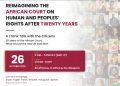
The conference themes, “Evidence Matters Before Regional Human Rights Courts: The African Court in Critical and Comparative Perspective,” was held from 11 to 13 May 2026 at the Future Africa Campus of the University of Pretoria in South Africa.
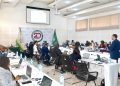
It brought together judges, academics, legal practitioners, researchers and students to reflect on how regional courts assess evidence and establish facts in human rights cases.
Discussions placed particular attention on the African Court’s growing body of case law and how its approach to evidence has developed over the past two decades. Emphasis was also placed on the unique opportunity presented by the Court’s relatively young jurisprudence to develop a more context-sensitive and human rights-oriented approach to evidence in international adjudication.
In the opening session, Dr Nkhata presented a presentation titled “A Critical Review of the Propriety of the Evidential Standards that the African Court is Applying in its Case Law on Reparations”.
The presentation critically examined the evidentiary standards applied by the African Court in its reparation’s jurisprudence, with particular focus on the challenges associated with proving harm, establishing causation, and determining appropriate remedies for victims of human rights violations.

Victor Lowilla presented a paper titled “Evidence, Fact-Finding and the Non-Fourth Instance Doctrine before the African Court: Navigating the Line between Human Rights Protection and Judicial Overreach.” which examined the manner in which the African Court assesses and relies upon evidence and factual findings originating from domestic courts, while interrogating the limits imposed by the non-fourth instance doctrine.
The presentation further emphasised the need for a clearer, more principled and consistent evidentiary approach in the Court’s jurisprudence
Hon. Justice Ben Kioko, former Judge of the African Court, delivered a keynote address titled “Reflections from the Court,” in which he shared insights on the evolution of the Court, its evidentiary practices and broader developments in regional human rights adjudication in Africa.
The conference is co-hosted by DISSECT: Evidence in International Human Rights Adjudication, an initiative of the European Research Council based at Ghent University and the Centre for Human Rights at the University of Pretoria.
Students from the University of Pretoria’s Master’s Programme in Human Rights and Democratisation in Africa also joined the sessions, contributing to exchanges between practitioners, scholars and the next generation of African human rights lawyers.
Through the participation of its current legal minds and a former Judge, the African Court continues to advance scholarly engagement, judicial dialogue and collaboration with academic institutions and practitioners in strengthening human rights protection across Africa.
As part of its 20th Anniversary, the Court is throughout the year engaging with a wide range of stakeholders, including academic institutions, practitioners and judicial actors, using such platforms to reflect on its work and foster dialogue.
NOTES FOR EDITORS:
- The African Court on Human and Peoples’ Rights (AfCHPR) is a continental court established by African countries to ensure the protection of human and peoples’ rights in Africa. The Court is an organ of the African Union and it complements and reinforces the functions of the African Commission on Human and Peoples’ Rights.
- The Court is composed of eleven Judges, nationals of Member States of the African Union elected in their individual capacity. The Court meets four times a year in Ordinary Sessions and may hold Extra-Ordinary Sessions.
- The Court’s mandate includes hearing cases and disputes concerning the interpretation and application of the African Charter on Human and Peoples’ Rights, as well as any other human rights instrument ratified by the concerned States.
Further information on the Court can be obtained from www.african-court.org Telephone: +255 272 510 510
For further inquiries: Ms Grace Wakio Kakai, Deputy Registrar – Registrar@african-court.org
For media inquiries: Chipiliro Liyana Kansilanga – Senior Information & Communication Officer and Head of Communication Unit Chipiliro.Kansilanga@african-court.org