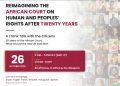




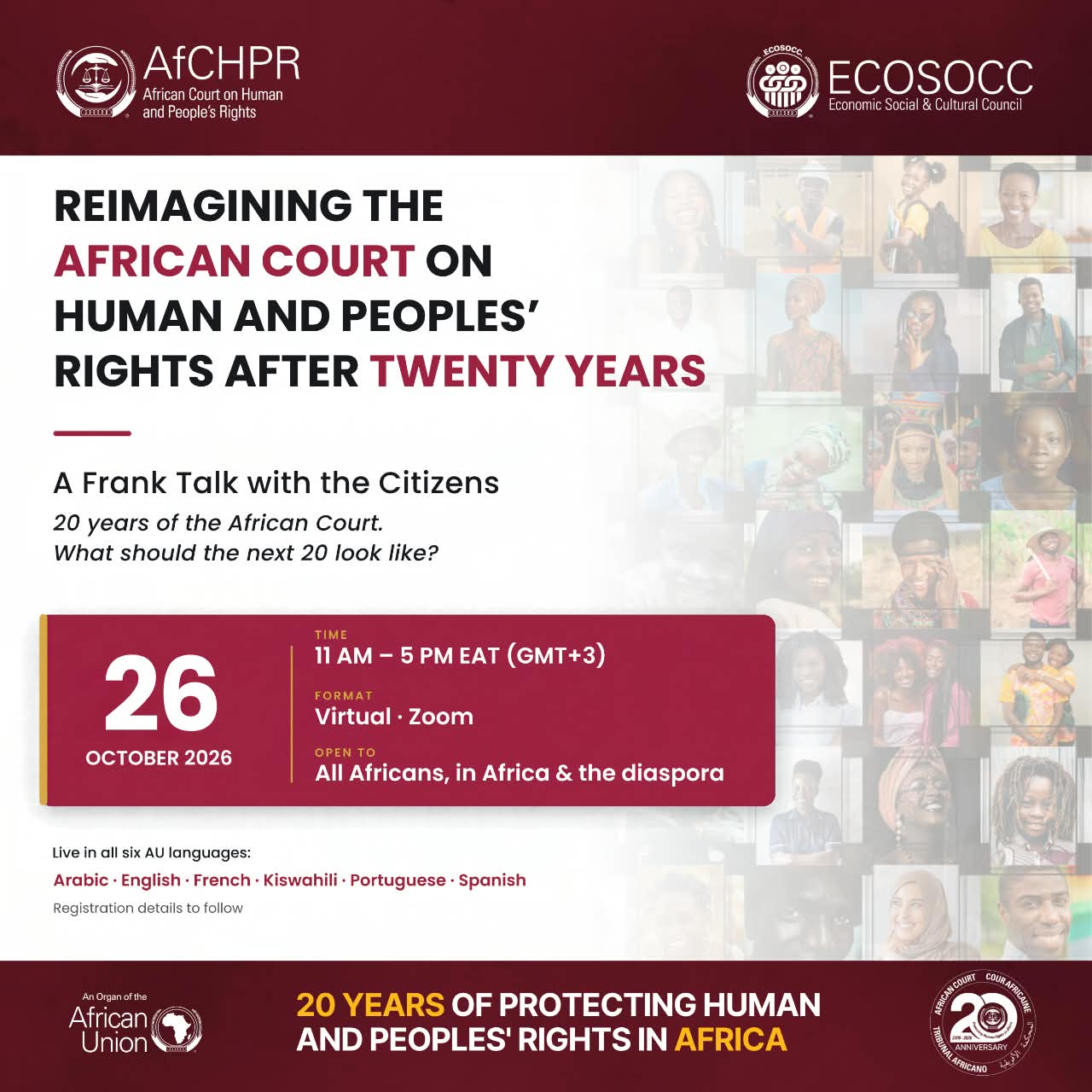
Arusha, 1 October 2026: The African Court on Human and Peoples’ Rights (AfCHPR), in collaboration with the African Union’s Economic, Social and Cultural Council (ECOSOCC), will host a virtual colloquium to engage African citizens in assessing the work and shaping the future of the Court as it commemorates 20 years of protecting human rights in Africa.
Under the theme “Reimagining the African Court after Twenty Years”, the Colloquium will provide a platform for citizens to share their perspectives on the Court’s achievements, challenges and priorities for the next two decades.
The event is scheduled for 26 October 2026, from 11:00 a.m. to 5:00 p.m. East African Time (GMT+3).
Designed as “A Frank Talk with the Citizens”, the Colloquium will offer an opportunity to African citizens to reflect on the Court’s work over the past two decades and propose practical ways to make it more accessible, effective and responsive to the needs of African people.
Ahead of the event, the President of the Court, Hon. Justice Blaise Tchikaya, emphasised the importance of giving citizens a voice in determining the Court’s priorities for the next twenty years.
“The Court was established to serve the African people. Their experiences and expectations must help shape its future. This colloquium is an opportunity to listen to citizens and hear their proposals on how we can strengthen access to justice and the protection of human and peoples’ rights,” he said.
Head of the ECOSOCC Secretariat, Ambassador William Carew, said the Colloquium would give citizens and civil society a platform to shape practical, actionable recommendations for strengthening the Court.
“Civil society works alongside communities every day and understands the real barriers people face in seeking justice. Those lived experiences must be at the heart of this discussion. “Through this Colloquium, we want citizens to put forward concrete proposals that can guide action by the Court, the African Union and civil society alike,” he said.
Discussions will focus on three areas: the Court’s effectiveness and State compliance with its decisions; the responsible use of technology and artificial intelligence to engage citizens; and priorities for the Court’s next twenty years.
The discussions are expected to inform a “Citizens’ Statement on Reimagining the African Court”, with recommendations to the African Union, the Court and civil society organizations.
The event will be open to African citizens on the continent and in the diaspora, human rights lawyers, civil society organisations, academics, students, journalists and digital creators.
To ensure diversity and accessibility, simultaneous interpretation will be available in all six official languages of the African Union; Arabic, English, French, Kiswahili, Portuguese and Spanish.
Participants will be required to register in advance. Registration details are indicated below:
Date: 26 October 2026
Time: 11:00 a.m. – 5:00 p.m. East African Time (EAT / GMT+3)
Platform: Virtual – Zoom
Registration: https://zoom.us/webinar/register/WN_wJT1XYH5Tr2qj6KNXqOxMA
NOTES FOR EDITORS:
- The African Court on Human and People’s Rights is a continental court established by African Union Member States to ensure the protection of human and peoples’ rights in Africa. The Court complements the protective mandate of the African Commission on Human and Peoples’ Rights and aims to enhance the protection of human rights on the African continent. The Court is composed of eleven Judges, nationals of Member States of the African Union, elected in their individual capacity. The Court meets four times a year in Ordinary Sessions and may hold Extra-Ordinary Sessions.
- The Economic, Social and Cultural Council (ECOSOCC) is an advisory and consultative Organ of the African Union established in July 2004. It provides a platform for civil society organisations, including social and professional groups across Africa and the diaspora, to contribute to the AU’s policies and programmes. Its Secretariat is based in Lusaka, Zambia. ECOSOCC strengthens partnerships between African governments and civil society, giving citizens a voice in shaping the continent’s future. Its membership includes non-governmental and community-based organisations, professional associations, cultural organisations and groups representing women, young people and other sections of society. https://ecosocc.au.int/
Further information on the African Court and ECOSSOC can be obtained from:
Dr. Robert Eno, Registrar, African Court: Robert.Eno@african-court.org
ECOSOCC Secretariat: ECOSSOCC@africanunion.org
—————————————————————————————
For partnerships, media & communication inquiries:
Ms. Chipiliro Liyana Kansilanga, Senior Information & Communication Officer, African Court:
Chipiliro.Kansilanga@african-court.org
Ms. Carol Jilombo, Senior Communications Officer, AU-ECOSSOC
Jilomboc@africanunion.org