


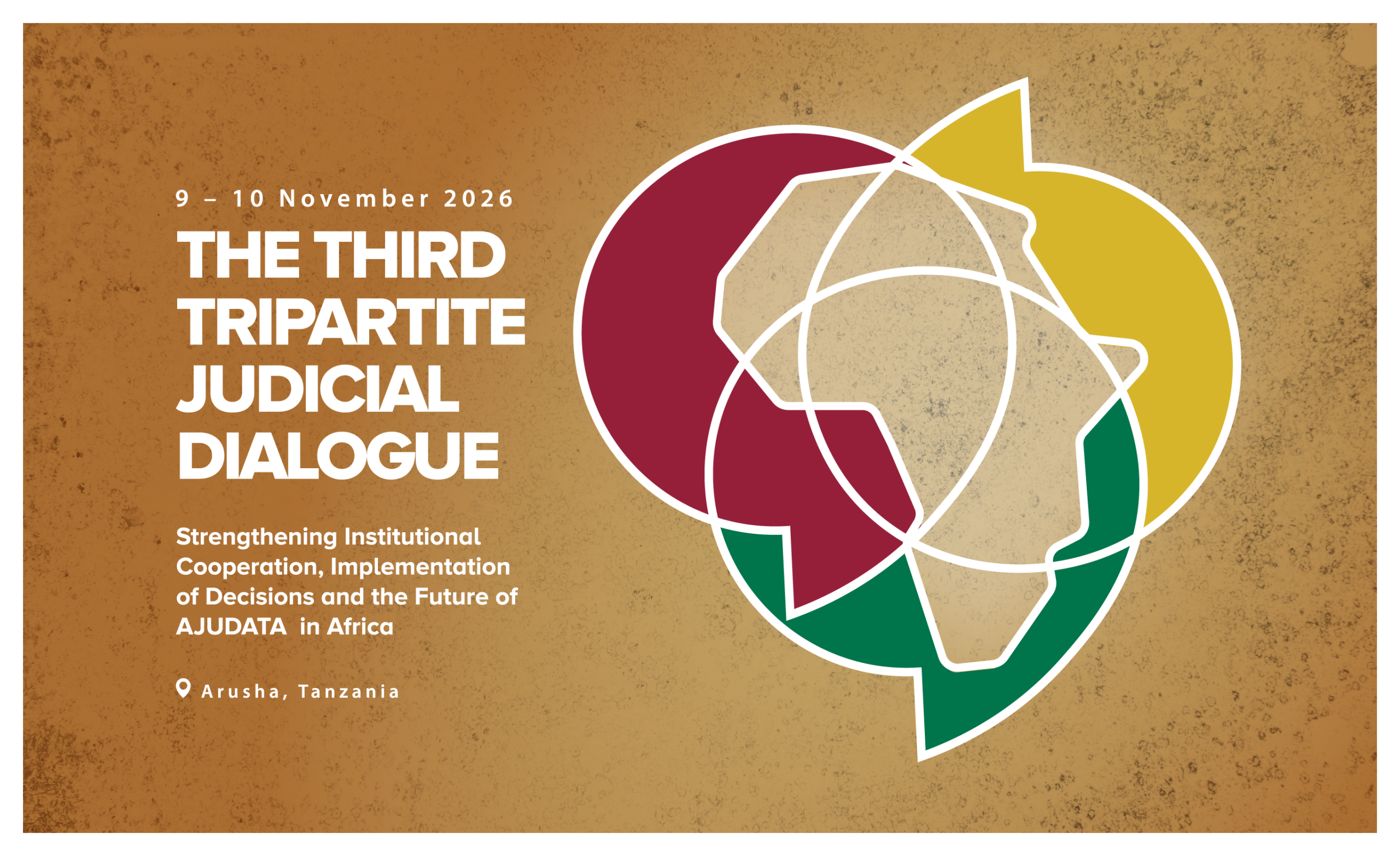
Arusha, 6 November 2026: The African Court on Human and Peoples Rights (AfCHPR), the East African Court of Justice (EACJ), and the Community Court of Justice, ECOWAS (CCJ) will convene for their 3rd Tripartite Judicial Dialogue, from 9-10 November 2026, in Arusha, United Republic of Tanzania.
The 3rd Tripartite Judicial Dialogue builds on the 1st and 2nd Tripartite Judicial Dialogues which aimed at enhancing cooperation among Africa’s Continental and Regional Courts. The 1st Tripartite Judicial dialogue took place from 27-29 June, 2022, in Zanzibar, United Republic of Tanzania during which the three Courts agreed to hold such Dialogues every two years. The 2nd Dialogue was subsequently held from 18 to 20 September 2024 in Arusha, United Republic of Tanzania.
The 3rd Tripartite Judicial Dialogue will be held under the theme “Strengthening Institutional Cooperation in Africa”, marking the continuation of collaboration among the three Courts through the bilateral Memoranda of Understanding (MoUs) and commitments made during the previous Dialogues.
Under these agreements, the three Courts committed to holding regular consultative forums to discuss common challenges, strengthen cooperation and promote the continuous exchange of information and expertise.
The 3rd Tripartite Judicial Dialogue will provide an opportunity for the Courts to assess progress made in implementing recommendations from the previous Dialogues, address challenges affecting the implementation of judicial decisions and identify practical measures to strengthen institutional cooperation. It serves as a platform for exchanging best practices and experiences in justice delivery, including the implementation of judicial decisions, access to jurisprudence and institutional cooperation.
This year’s Dialogue will bring together Judges and Registry staff from the three Courts, representatives of partner institutions, including United Nations human rights treaty bodies, and other stakeholders to exchange experiences, discuss common challenges and explore practical solutions to strengthen justice delivery across Africa.
The Dialogue will cover a wide range of topics, including the implementation and monitoring of judicial decisions, institutional cooperation, environmental rights and climate justice, and the future development of the African Jurisprudence Data Base (AJUDATA), aimed at improving access to African jurisprudence and legal resources.
It is expected to produce practical recommendations to strengthen cooperation among the three Courts, improve the implementation of judicial decisions and identify opportunities for future joint initiatives.
The Dialogue takes place as the African Court marks its 20th anniversary and the East African Court of Justice celebrates its 25th anniversary. Immediately following the Dialogue, the two Courts will hold their respective commemorative activities, a colloquium and a ceremony, back-to-back in Arusha, Tanzania, to mark these milestones.
The event is being organised jointly by the three Courts in collaboration with partners, including the Raoul Wallenberg Institute for Human Rights and Humanitarian Law (RWI), the Swedish International Development Cooperation Agency (Sida), Konrad-Adenauer-Stiftung (KAS), the Office of the United Nations High Commissioner for Human Rights (OHCHR) and the United Nations Development Programme (UNDP).
NOTES FOR EDITORS:
- The African Court on Human and People’s Rights is a continental court established by African countries to ensure the protection of human and peoples’ rights in Africa. The Court complements the protective mandate of the African Commission on Human and Peoples’ Rights and aims to enhance the protection of human rights on the African continent. The Court is composed of eleven Judges, nationals of Member States of the African Union, elected in their individual capacity. The Court meets four times a year in Ordinary Sessions and may hold Extra-Ordinary Sessions. www.african-court.org
- The East African Court of Justice (EACJ or ‘the Court’), is one of the organs of the East African Community established under Article 9 of the Treaty for the Establishment of the East African Community. The Court was established in November 2001, its key mandate is to ensure the adherence to law in the interpretation and application of and compliance with the EAC Treaty. Arusha is the temporary seat of the Court until the Summit determines its permanent seat. The Court’s sub-registries are located in the capitals of the following Partner States: Burundi, Kenya, Rwanda, Uganda and United Republic of Tanzania. www.eacj.org
- The ECOWAS Court of Justice is an organ of the Economic Community of West African States (ECOWAS), a regional integration community consisting of 15 member states in West Africa. While ECOWAS was founded in 1975 by the Treaty of Lagos, the Court of Justice was established in 1991 through the adoption of the Protocol on the Community Court of Justice. The Court of Justice is an institution of ECOWAS as outlined in the ECOWAS Revised Treaty of 1993. The Protocol was amended in 2005 expanding the Court’s jurisdiction to include human rights claims by individuals. www.courtecowas.org
Further information on the Courts can be obtained from: Dr Robert Eno, Registrar, African Court: Robert.Eno@african-court.org
Ms. Christine Mutimura, Acting Registrar, East African Court of Justice: cmwekesa@eachq.org
Mr. Saidu Vasco NYEI, Executive Assistant to the Hon President, Community Court of Justice, ECOWAS: snyei@courtecowas.org
Focal points for the 3rd Tripartite Judicial Dialogue Mr. Maulo Nfinda Dombaxi, Legal Officer, African Court: Maulo.Dombaxi@african-court.org
Ms Christine Mutimura, Acting Registrar, East African Court of Justice: cmwekesa@eachq.org
Mrs. Marie Saine- Acting Deputy Chief Registrar, Community Court of Justice, ECOWAS: msaine@courtecowas.org
For media & communication inquiries: Chipiliro Kansilanga Ngue, Senior Information & Communication Officer and Head of Communication: Chipiliro.Kansilanga@african-court.org
Elohor Ovadje, Head of the Public Information and External Relations Division, eovadje@courtecowas.org