African Court's Calender of Events
African Court's NewsletterHow was the Court established?
What is the composition of the Court?
What is the Court's Jurisdiction?
Who can make an Application to the Court?
What are the Court's official Languages?
What are the directions to guide litigants?
How to file an Application to the Court?
What are the conditions for sending an Application ?
Which is the applicable Law for the Court?
What is the nature of the Court’s findings?
How long does the Court take to give a Judgment?
The African Court on Human and Peoples' Rights was established by the Protocol to the African Charter on Human and Peoples' Rights on the Establishment of an African Court on Human and Peoples' Rights (Court's Protocol). The African Charter on Human and Peoples' Rights (Charter) is the main African human rights instrument that sets out the rights and duties relating to human and peoples' rights. The Charter establishes the African Commission on Human and Peoples' Rights (Commission), which is a quasi-judicial body that monitors the implementation of the Charter.
In 1998, the 34th Ordinary Session of the Assembly of Heads of State and Government of the Organisation of African Unity (now the African Union), meeting in Ouagadougou, Burkina Faso, adopted the Court's Protocol. This Protocol entered into force on 25 January 2004, paving the way for the operationalisation of the Court.
The Court's mission is to complement and reinforce the functions of the Commission in promoting and protecting human and peoples' rights, freedoms and duties in African Union Member States. The Commission, being a quasi-judicial body can only make recommendations while the Court makes binding decisions.
The Court is composed of eleven (11) Judges, nationals of Member States of the African Union elected in an individual capacity. The Judges are elected by the Assembly of Heads of State and Government of the African Union for a period of six (6) years and may be reelected only once. For the purposes of continuity, the incepting Judges are allocated a term of two, four and six years and if thereafter they are elected, their second term will be for six years. All Judges except the President perform their functions on a part-time basis. The Court meets four times a year in Ordinary Sessions lasting two weeks each and in Extra-Ordinary Sessions as necessary. The President of the Court is Hon. Justice Gérard Niyungeko and the Vice President is Hon. Justice Sophia A. B. Akuffo.
The Court has jurisdiction over all cases and disputes submitted to it regarding the interpretation and application of the Charter, the Court's Protocol and any other relevant human rights instrument ratified by the concerned States.
The Court's official languages are the same as those of the African Union. The official languages of the African Union are set out in the Constitutive Act of the African Union as being Arabic, English, French and Portuguese.
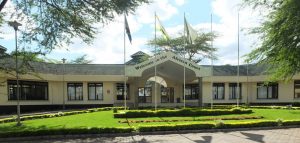
Cases shall be submitted by post, email, fax or courier to the Registrar, in terms of Rule 25 and Rule 34, at the seat of the Court, in Arusha, Tanzania.
The Registrar has custody of the seal and official stamp of the Court with which to officially acknowledge receipt of any case submitted. The term "Registrar" here is used in its widest meaning : that of the registry "Office" rather than the person or officer. For in the absence of the person, the office will continue to function.
One has to send to the Court's Registry a signed application written in one of the Court's official languages.
For applications by individuals and NGOs, the application must:
In addition to the above requirements, applications by individuals and NGOs should indicate, and this also applies to applications by entities other than individuals and NGOs:
The Court shall apply the provisions of the Charter and any other relevant human rights instruments ratified by the States concerned. The Charter provides that the sources of law that apply for the monitoring of the implementation of the Charter are international law on human and peoples' rights, particularly from the provisions of various African instruments on human and peoples' rights, the Charter of the United Nations, the Charter of the Organisation of African Unity, now the Constitutive Act of the African Union, the Universal Declaration of Human Rights, other instruments adopted by the United Nations and by African countries in the field of human and peoples' rights as well as from the provisions of various instruments adopted within the Specialized Agencies of the United Nations of which the parties to the Charter are members.
When the Court finds that there has been a violation of human and peoples' rights, it will issue appropriate orders to remedy the violation, including the payment of fair compensation or reparation.
In cases of extreme gravity and urgency, and when necessary to avoid irreparable harm to persons, the Court can adopt provisional measures as necessary. An example of a situation which necessitates adoption of provisional measures is when a death sentence is to be executed and the appeals process has not been exhausted.
The Court gives its judgment within ninety (90) days of having completed its deliberations. Its judgment is final and not subject to appeal. However, in light of new evidence, which was not within the knowledge of a party at the time the judgment was delivered, a party may apply for review of the judgment. This application must be within six months after that party acquired knowledge of the evidence discovered. The Court may also interpret its own decision.
Tel +255-732-97 95 09 / +255-732-97 95 51
Fax +255-732-97 95 03
Website: www.african-court.org
Email:
This email address is being protected from spambots. You need JavaScript enabled to view it.